Warm-Up and Cool-Down Routines to Help Prevent Workout Injuries
You may be motivated to exercise, short on time, and tempted to jump straight into squats, running, yoga, or strength training.
But spending just a few minutes warming up first can make your workout feel smoother, safer, and more comfortable. The same is true at the end: instead of suddenly stopping after an intense session, a short cool-down helps your body gradually return to a resting state.
For beginners, the best warm-up and cool-down routines are not complicated. You do not need special equipment, fancy stretches, or 30 extra minutes. You only need a few simple movements that match the workout you are about to do.
This guide gives you an easy routine you can use before and after home workouts, gym workouts, walking, running, yoga, or beginner strength training.
This article is for general education only and is not medical advice. If you have an injury, severe or persistent joint pain, dizziness, a heart condition, or any health concern, speak with a qualified healthcare professional before beginning a new exercise program.
Affiliate Disclosure
Affiliate Disclosure: Some links in this article may be affiliate links. If you purchase through them, I may earn a small commission at no extra cost to you. I only recommend products that I would be comfortable suggesting to a close friend.
Why warm-ups and cool-downs matter
A warm-up prepares your body for more intense movement. It increases blood flow, raises muscle temperature, helps your joints move more comfortably, and gives your mind a few minutes to focus on your workout. Warm muscles are more pliable and less likely to be strained than cold muscles.
A cool-down does the opposite: it gently brings down your heart rate and helps you transition from exercise to rest. Rather than stopping suddenly after running, skipping, or a hard gym session, slow your pace gradually for a few minutes. Most exercise-safety guidance recommends a cool-down of roughly 5–10 minutes.
Warm-ups and cool-downs reduce risk, but they cannot guarantee that you will never get injured. Good form, realistic progression, sleep, rest days, proper footwear, and listening to pain signals are equally important.
Dynamic versus static stretching
Knowing this difference will make your workouts safer.
| Type of movement | What it means | Best time to use it | Examples |
|---|---|---|---|
| Dynamic stretching | Controlled movement through a comfortable range of motion | Before your workout | Arm circles, leg swings, hip circles, bodyweight squats |
| Static stretching | Holding a comfortable stretch without bouncing | After your workout | Quad stretch, calf stretch, chest stretch, hamstring stretch |
Before a workout, use dynamic movements because they prepare the muscles and joints for movement. Very long static stretches immediately before intense exercise may reduce performance for some people, so save longer holds for after your session.
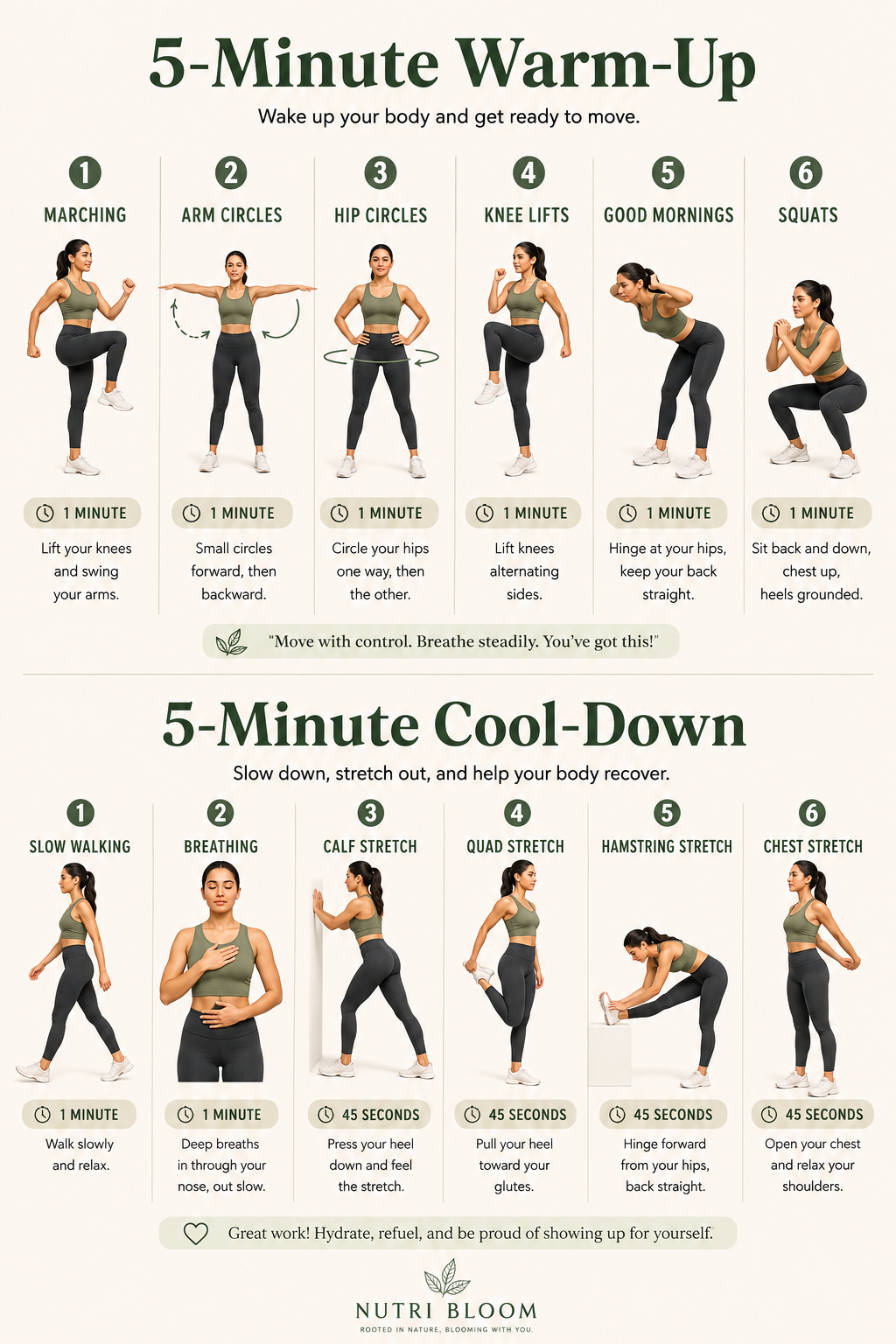
Your 5-minute full-body warm-up
Use this before most home workouts, gym workouts, walking, or beginner strength sessions.
Do each movement for about 30–45 seconds. Move gently and stay within a comfortable range. You should feel warmer by the end, but you should not feel tired.
1. Easy march in place
- Stand tall and march slowly.
- Swing your arms naturally.
- Lift your knees only as high as feels comfortable.
- Gradually make the march slightly faster.
This gently raises your heart rate and prepares your body to move.
2. Shoulder rolls and arm circles
- Roll both shoulders backward 10 times, then forward 10 times.
- Make small arm circles for 15 seconds.
- Make slightly bigger circles for another 15 seconds.
This is especially useful before upper-body workouts, push-ups, rows, shoulder presses, or gym machines.
3. Standing torso rotations
- Stand with your feet hip-width apart.
- Keep your hips mostly facing forward.
- Rotate your upper body gently from side to side.
- Allow your arms to move naturally.
This helps warm the upper body and trunk without forcing a deep twist.
4. Hip circles
- Put your hands on your hips.
- Make slow, comfortable circles with your hips in one direction.
- Switch direction after 15–20 seconds.
Hip circles are useful before squats, lunges, walking, running, cycling, and lower-body strength training.
5. Alternating knee lifts
- Stand tall and lightly lift one knee at a time.
- Keep the movement controlled.
- If balance is difficult, hold a wall or chair lightly.
This prepares the hips and core for walking, running, leg exercises, and lower-body workouts.
6. Bodyweight good mornings
- Stand with your feet hip-width apart and place your hands on your hips.
- Keep a soft bend in your knees.
- Push your hips back as your chest leans slightly forward.
- Keep your back neutral, then squeeze your glutes to stand tall again.
- Repeat slowly for 8–10 repetitions.
This prepares your glutes, hamstrings, and hips for squats, deadlifts, or lower-body workouts.
7. Slow bodyweight squats
- Stand with feet around shoulder-width apart.
- Push your hips back and bend your knees comfortably.
- Keep your chest lifted and knees tracking in the direction of your toes.
- Stand back up with control.
- Do 8 slow repetitions.
If you are a total beginner, squat toward a chair and lightly touch it before standing.
Warm-ups for different workouts
Your general warm-up works well for most routines. But if you have extra time, add one or two movements specific to your workout.
Before walking or running
After your five-minute warm-up:
- Walk slowly for another 2–3 minutes
- Do gentle ankle circles
- Do 10 calf raises
- Perform 8–10 controlled leg swings per side, holding a wall for balance
Start your actual walk or run gradually. For example, begin with slow walking, move to brisk walking, then increase pace only if your body feels ready.
Before a lower-body workout
Add:
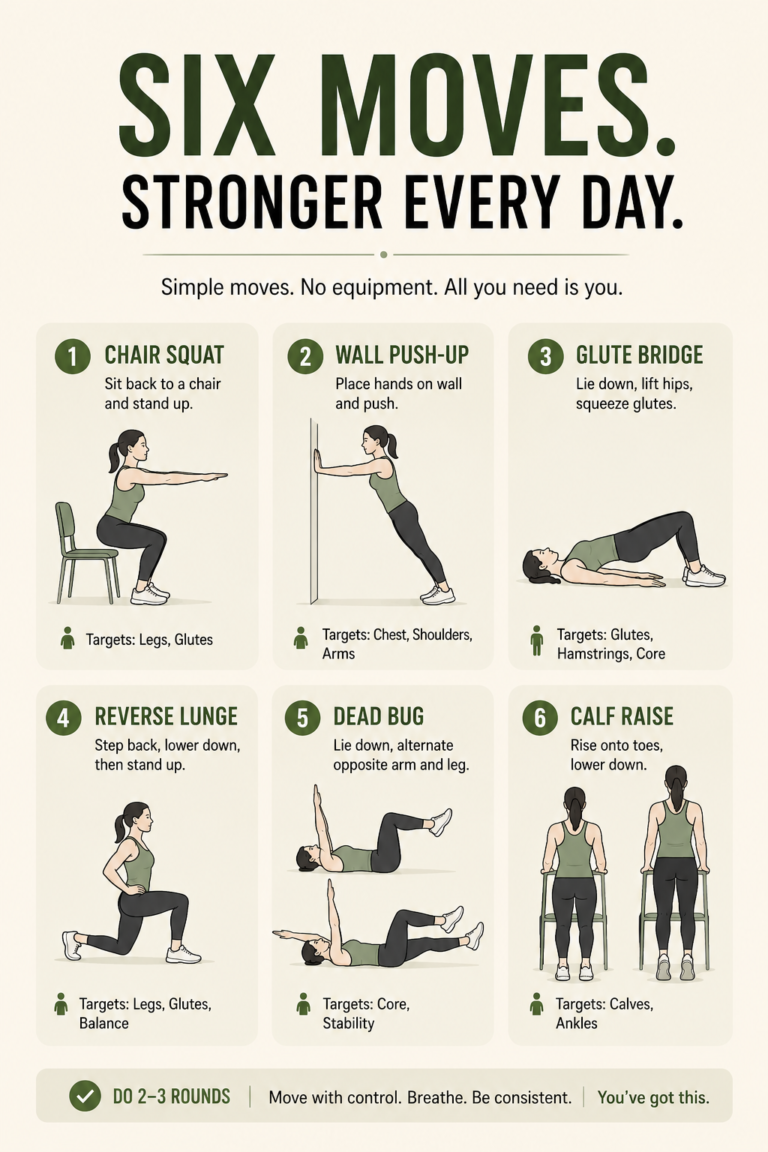
- 10 glute bridges
- 8 reverse lunges per side, using a chair or wall for support
- 10 calf raises
- 10 bodyweight squats
This prepares your glutes, thighs, knees, ankles, and hips for squats, lunges, leg presses, and deadlifts.
Before an upper-body gym workout
Add:
- 10 wall push-ups
- 10 light band pull-aparts
- 10 light cable rows or machine rows
- One very light practice set before your first working set
Use light weights for practice; your warm-up should prepare your muscles, not fatigue them.
Before yoga or Pilates
Add:
- Cat-cow movements
- Shoulder rolls
- Hip circles
- Gentle sun salutations at a slow pace
- Wrist circles if you will be doing planks or downward dog
Do not force yourself into deep stretches at the beginning. Let your range of motion increase as your body warms up.
Your 5–10 minute cool-down routine
After walking, gym training, running, or a home workout, do not stop instantly. Spend a few minutes bringing the intensity down.
Step 1: Walk slowly for 2–3 minutes
If you were running, move to a slow jog, then to a gentle walk. If you were lifting weights, walk around slowly, breathe deeply, and let your heart rate settle.
A gradual transition is a simple way to help avoid feeling dizzy or light-headed after exercise.
Step 2: Slow breathing for 30–60 seconds
- Stand or sit comfortably.
- Breathe in slowly through your nose.
- Exhale slowly through your mouth.
- Drop your shoulders and relax your jaw.
This is a simple way to signal that the workout is over and help your body shift toward recovery.
Step 3: Gentle static stretches
Hold each stretch for 20–30 seconds. Do not bounce. You should feel a mild stretch, not pain.
Quad stretch
- Hold a wall or chair for balance.
- Bend one knee and bring your heel toward your glutes.
- Hold your ankle or trouser leg gently.
- Keep your knees close together.
- Repeat on the other side.
Hamstring stretch
- Place one heel on a low step or keep both feet on the floor.
- Keep your back long and hinge forward gently from the hips.
- Do not round aggressively or force your hands toward your toes.
Calf stretch
- Place your hands on a wall.
- Step one leg back and keep that heel on the floor.
- Bend the front knee slightly.
- Hold, then switch sides.
Chest stretch
- Stand near a wall or doorway.
- Place one hand or forearm gently on it.
- Slowly turn your body away until you feel a mild stretch across your chest and shoulder.
- Switch sides.
Child’s pose or gentle back stretch
- Kneel on a mat if comfortable.
- Sit hips back toward heels and extend your arms forward.
- Breathe slowly.
If kneeling is uncomfortable, lie on your back and gently hug your knees toward your chest instead.
A simple cool-down after a walk
If you have only five minutes after a brisk walk, do this:
- Walk slowly for 2 minutes
- Calf stretch: 20 seconds per side
- Quad stretch: 20 seconds per side
- Hamstring stretch: 20 seconds per side
- Five slow, deep breaths
That is enough. You do not need a 30-minute stretching session after every walk.
A simple cool-down after strength training
After a home or gym strength workout:
- Walk slowly for 2–3 minutes
- Stretch the muscles you trained most: quads, hamstrings, glutes, chest, shoulders, or back
- Hold each stretch for 20–30 seconds
- Breathe slowly
- Drink water and plan a protein-rich meal or snack if needed
Other habits that lower injury risk
A warm-up helps, but your overall routine matters more.
Increase intensity gradually
Do not go from no exercise to seven intense workouts in one week. Add time, repetitions, weight, or walking distance gradually. Pushing too hard too fast is a common reason beginners develop aches and quit.
Learn proper form
Use a mirror, watch credible exercise demonstrations, or ask a gym trainer to check your form. A slow squat with good technique is better than 30 rushed squats.
Wear suitable footwear
For walking, running, and gym workouts, wear shoes that feel secure and comfortable. If your shoes are worn out or slide easily, replace them before increasing your walking or workout volume.
Hydrate, especially in hot weather
India’s heat and humidity can make outdoor workouts harder. Drink water before, during, and after exercise, especially if you sweat heavily. Exercise in cooler morning or evening hours where possible.
Rest when your body needs it
Normal muscle soreness can happen after a new workout. But sharp pain, sudden swelling, numbness, chest pain, severe dizziness, or pain that gets worse each day is not normal. Stop and seek medical advice when needed.
Common warm-up and cool-down mistakes
Skipping both because you are short on time
You do not need to spend 20 minutes on each. Even five focused minutes before and after training are better than doing nothing.
Doing deep static stretches before intense workouts
Before strength training, running, or sports, prefer dynamic movements that prepare your joints and muscles for motion. Save longer held stretches for afterward.
Treating warm-up sets as real workout sets
Your warm-up weights should feel easy. Do not tire out your muscles before your actual working sets.
Stretching through pain
A stretch should feel like mild tension, not sharp pain, burning, or tingling. Never force your range of motion.
Stopping suddenly after intense cardio
Gradually reduce your pace instead. Walk slowly for a few minutes before you stretch.
Frequently asked questions
How long should a warm-up be?
For most beginner workouts, around 5–10 minutes is enough. Begin with light movement, then use dynamic mobility exercises that match the workout you plan to do.
Is stretching before a workout good?
Dynamic movement and mobility drills are generally better before a workout. Save longer static stretches—where you hold a position—for after training.
Is a cool-down necessary after every workout?
A 5–10 minute cool-down is especially useful after intense cardio, running, skipping, or tough strength training. After a gentle walk or very light session, a brief slow walk and a few comfortable stretches may be enough.
Can warm-ups completely prevent injuries?
No. Warm-ups reduce risk by preparing the body, but no routine can guarantee injury prevention. Correct technique, gradual progression, appropriate rest, and listening to your body are equally important.
Should I stretch if I am very sore?
Gentle mobility and light stretching can feel good, but avoid forcing sore muscles into deep stretches. If soreness is severe, unusual, or becomes sharp pain, rest and consider speaking with a healthcare professional.
Final thoughts
Warm-ups and cool-downs do not need to be complicated to be useful. Before your workout, spend five minutes moving dynamically and preparing the parts of your body you will use. Afterward, lower your pace gradually, breathe, and stretch gently.
These small habits make your workouts feel more comfortable and help you build the consistency that matters most.